Address
Miami Florida, 3475 Sheridan St, Hollywood, Florida, 33021
Make a Call
(877)-238-0307
Mon - Sat: 09am - 09pm
Address
Miami Florida, 3475 Sheridan St, Hollywood, Florida, 33021
Make a Call
(877)-238-0307
Mon - Sat: 09am - 09pm


Toronto to Miami has never been more relevant as Canadian investors explore cross-border opportunities, the comparison between real estate returns . With housing market shifts, currency fluctuations, and evolving tax structures, understanding real estate ROI (Return on Investment) in both cities is crucial for informed investment decisions. This blog offers a detailed, unbiased, and purely informational comparison to help Canadians make data-driven choices.
Toronto remains Canada’s financial and cultural hub. As of mid-2026, the average price of a detached home is around CAD $1.4 million, with condos averaging CAD $720,000. Price growth has slowed due to higher interest rates and stricter mortgage rules. However, population growth and limited housing supply continue to support long-term price appreciation.
Average gross rental yields in Toronto hover around 3% to 4% for condos, slightly higher in suburbs. Rent control and tenant protection laws may limit profitability but offer long-term stability. Vacancy rates in the downtown core have slightly increased post-pandemic, though rental demand remains solid in key transit-oriented developments.

Miami has rebounded post-pandemic with strong migration and foreign investment. As of 2026:
Rental yields in Miami average between 5% to 7%, with short-term rental markets (Airbnb) potentially offering up to 10% ROI, especially in tourist-heavy areas like South Beach. However, HOA restrictions and municipal regulations may limit short-term rentals in some zones.
Fluctuations between CAD and USD play a crucial role in cross-border ROI. In 2026, the CAD trades around 0.74 to 0.78 USD, meaning:
Over the last five years (2020-2025), both cities have experienced notable appreciation, but Miami has outpaced Toronto due to migration trends and tax benefits.
| Year | Toronto Avg. Appreciation | Miami Avg. Appreciation |
|---|---|---|
| 2020 | 6% | 4% |
| 2021 | 7% | 9% |
| 2022 | 5% | 10% |
| 2023 | 3% | 6% |
| 2024 | 4% | 8% |
| 2025 | 5% (projected) | 9% (projected) |
Miami has benefited from tax migration and tech/finance sector relocations, while Toronto’s price growth has stabilized after sharp gains during 2020–2021. Miami’s pro-business environment and weather have driven higher speculative and lifestyle-driven investment, which contributes to above-average appreciation.
Here’s how gross rental yield compares for similar condo investments.
Rental Yield Comparison Table
| City | Avg Property Price | Avg Monthly Rent | Gross Yield (%) |
| Toronto | CAD $720,000 | CAD $2,400 | 4% |
| Miami | USD $430,000 | USD $2,800 | 7.8% |
Miami offers better rental yield due to higher rent-to-price ratio and favorable short-term rental economics. Toronto’s lower rental yields are offset by lower volatility and stronger regulatory protection for landlords and tenants.
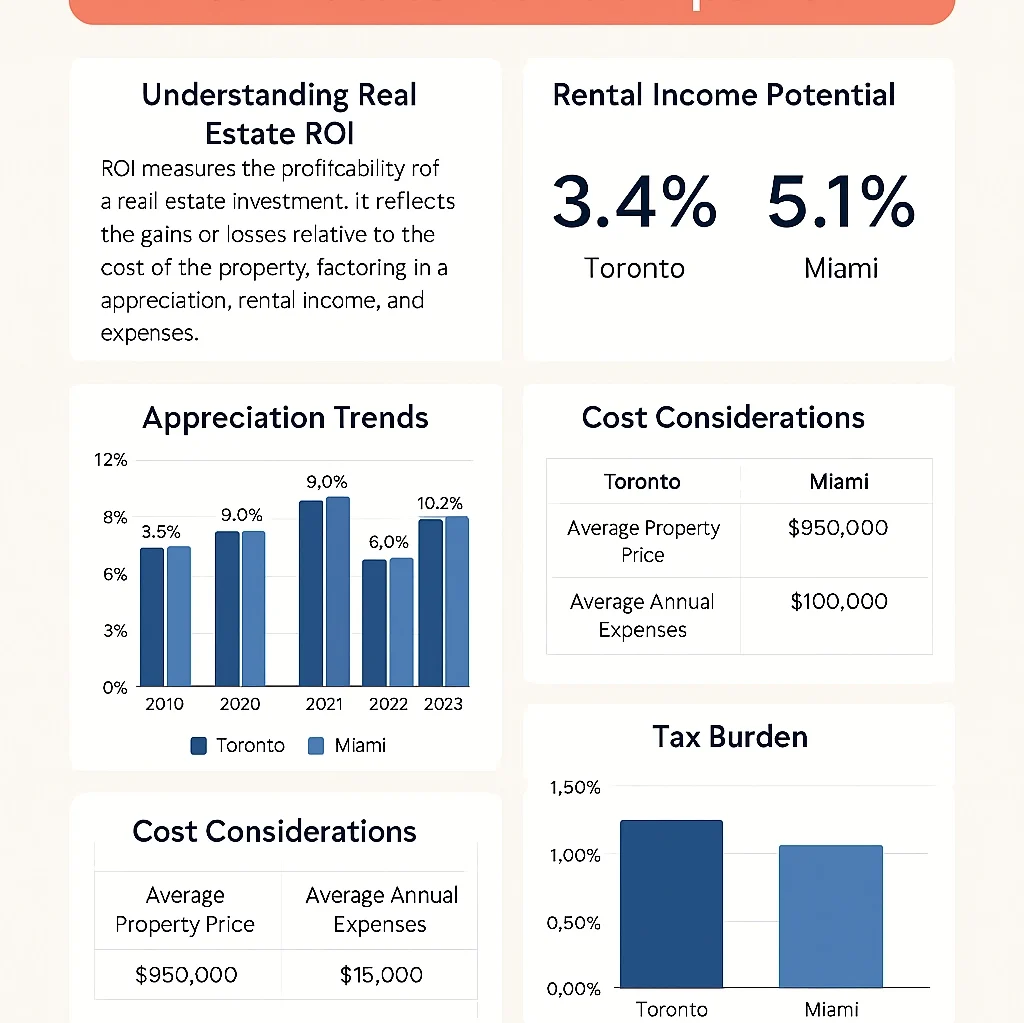
Tax Burden Comparison Table
| Tax Category | Toronto, Canada (CAD) | Miami, USA (USD) |
| Property Tax | 0.61% to 1.2% | 1% to 1.5% |
| State Income Tax | None | None |
| Capital Gains Tax | 50% of gain taxable | FIRPTA: 15% withheld |
| Speculation Tax | 25% NRST for foreign buyers | None |
| Withholding on Sale | None | FIRPTA applies for Canadians |
While Toronto has predictable tax structures, Miami benefits from Florida’s lack of state income tax and absence of speculation tax. FIRPTA withholding adds complexity for Canadians selling U.S. property, but refunds can be obtained with proper tax filings.
Toronto is ideal for:
Miami is ideal for:
| Feature | Toronto (CAD) | Miami (USD) |
| Purchase Price | $600,000 | $600,000 |
| Rental Income (Annual) | $21,000 | $36,000 |
| Appreciation (5 Years) | $150,000 | $225,000 |
| Net ROI (Est.) | ~5% annually | ~8% annually |
Miami outperforms Toronto in short-to-mid term ROI with stronger rental income and appreciation. However, Canadian investors must weigh additional legal, tax, and currency risks. Toronto, while offering lower returns, provides greater predictability and ease of management.
Yes, there are no restrictions. You can buy as an individual or through an LLC.
Miami offers higher rental yields (5-7%) vs. Toronto’s (3-4%) but may have more operational costs.
Yes. The Canada-U.S. Tax Treaty helps prevent double taxation, but professional advice is recommended.
Miami, due to its year-round tourism and favorable short-term rental laws.
Yes, but expect a larger down payment and higher interest rates from U.S. lenders.
Whether you’re a conservative investor favoring the stable growth of Toronto or a risk-taker eyeing the dynamic returns of Miami, both markets present unique advantages. Toronto shines in long-term predictability and regulatory clarity, while Miami boasts higher yields and tax efficiencies attractive to international buyers. By aligning your goals, financial strategy, and tolerance for cross-border complexity, you can make informed investment choices that perform well over time from Toronto to Miami. Ready to make your next move? Explore our featured Miami listings or book a personalized consultation to get expert guidance tailored to your goals.